The technology expo was packed from the moment the doors opened.
Large displays filled the exhibition hall, companies demonstrated their newest products, and visitors moved from booth to booth searching for the next big innovation.
Near the back of the hall, one small stand attracted almost no attention.
There were no giant screens or elaborate displays.
Only a young developer, a simple table, and a sleek laptop.
Most people walked past without stopping.
Then one visitor paused.
He wore a tailored suit and carried the quiet confidence of someone who had spent years in the technology industry.
He glanced at the table.
“Is this your entire presentation?”
The developer smiled.
“It is. Give me a minute.”
He opened the laptop.
At first glance, it looked like any modern computer.
The visitor shrugged.
“It seems familiar.”
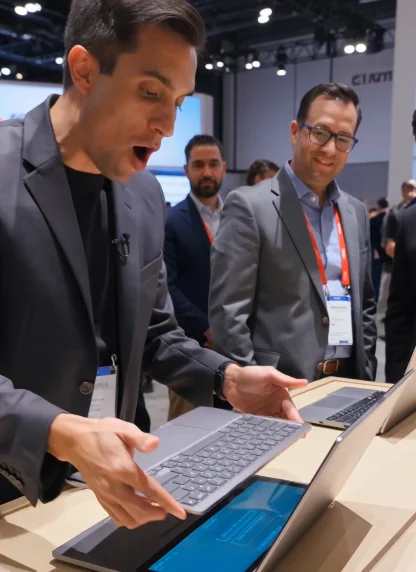
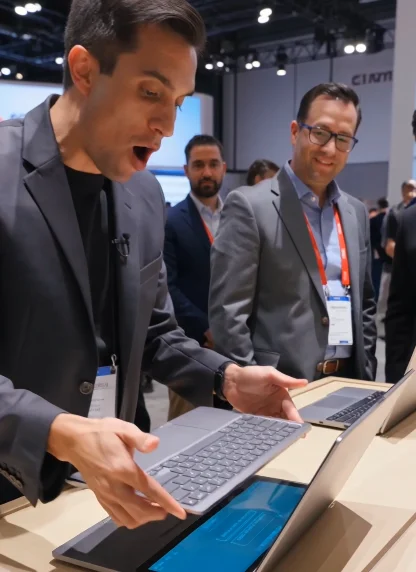
Without saying anything, the developer gently lifted the physical keyboard.
To the visitor’s surprise, it detached smoothly.
Beneath it, a bright interactive display came to life.
The laptop instantly transformed into a full touchscreen workspace with a customizable digital keyboard.
The visitor leaned in for a closer look.
The developer demonstrated how the layout could change with a simple gesture. One swipe switched from a keyboard to drawing tools. Another displayed editing controls designed for creative work.
Everything responded instantly.
No delays.
No complicated setup.
Just a seamless transition between different ways of working.
People walking nearby began slowing down.
Curiosity spread through the aisle.
Within minutes, a small crowd had gathered around the demonstration.
“How quickly does it adapt?” the visitor asked.
The developer smiled.
“It’s designed to adapt as fast as people work.”
The answer drew even more attention.
The visitor studied the prototype for another moment before asking a different question.
“Who designed this?”
The young inventor paused briefly.
“I’ve spent years developing it with a small team that believed personal computers could be more flexible without becoming more complicated.”
The visitor nodded thoughtfully.
Sometimes the most interesting ideas, he realized, don’t come from the biggest booths.
They come from people quietly solving problems.
As the demonstration ended, the developer closed the laptop.
Around him, dozens of visitors were now recording videos, asking questions, and waiting for their chance to see the prototype.
Only a few minutes earlier, almost no one had noticed the small booth.
Now it had become one of the busiest places in the exhibition hall.
Ending
By the end of the event, the young developer had spoken with engineers, investors, and technology enthusiasts from around the world.
His prototype reminded everyone of a simple truth: innovation isn’t measured by the size of a display or the budget behind it.
Sometimes, the most memorable ideas begin with a quiet demonstration—and a product that speaks for itself.