The courtroom was unusually quiet that morning.
It was supposed to be a routine custody hearing, but everyone in the room sensed that something important was about to happen.
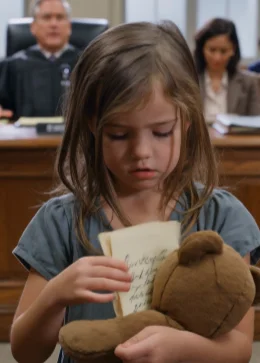
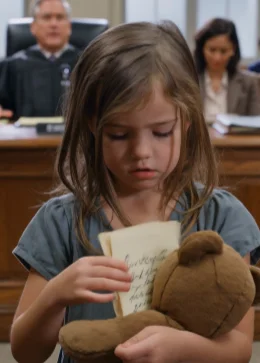
At the center stood a seven-year-old girl, holding a worn teddy bear tightly against her chest.
On one side sat her father, Daniel.
His suit was old but carefully pressed. He looked exhausted, yet his attention never left his daughter.
Across the room sat her mother, Elena, calm and composed.
According to the documents presented to the court, Daniel had been absent from his daughter’s life for years.
There were no recorded visits.
No documented financial support.
And, most importantly, no evidence that he had tried to maintain contact.
Daniel had repeatedly insisted that the records were incomplete.
“I never stopped trying to reach her,” he had told the court.
But without evidence, his words were difficult to verify.
Near the end of the hearing, the judge looked toward the girl.
“Before I make my decision, is there anything you’d like to say?”
The girl stepped forward.
She looked at the judge, then at her father.
Her voice was quiet.
“Why did everyone tell me he didn’t want me?”
Daniel immediately looked up.
“What?”
The girl continued.
“He never wrote to me?”
Daniel’s expression changed.
“I did,” he said. “I wrote to you all the time.”
The girl looked confused.
Then she hugged her teddy bear even tighter.
After a moment, she turned it around.
There was a small, uneven section of stitching on its back.
She carefully opened it.
Then she began pulling out folded pieces of paper.
One.
Then another.
Then several more.
The courtroom fell silent.
They were letters.
Dozens of them.
Old, carefully folded letters addressed to the same child.
The judge asked where she had found them.
“They were inside my teddy bear,” she answered. “I found them yesterday.”
Daniel stood slowly.
His eyes filled with emotion.
“I sent those,” he whispered.
The judge examined several of the letters.
Each carried a date.
Each was addressed to the girl.
And none appeared to have been opened.
The judge looked across the courtroom.
“Elena, can you explain why these letters were never delivered?”
For several seconds, she said nothing.
Then she quietly replied:
“I thought it was better this way.”
The judge’s expression became serious.
“That’s not a decision one parent should make without considering the child’s rights and interests.”
The court ordered the relevant records and communications to be reviewed before making any final custody decision.
But the most important moment happened outside the legal process.
The girl slowly walked toward Daniel.
She stopped in front of him.
“Were you really writing to me?”
Daniel nodded.
“Every time I could.”
She studied his face for a few seconds.
Then asked:
“Why didn’t you come?”
“I tried,” he answered softly. “I just didn’t know where you were.”
The girl lowered her teddy bear.
Then she stepped forward and hugged him.
Daniel closed his eyes and held her carefully.
For the first time that day, neither of them needed to explain anything.
The Final Letter
Later that evening, the judge reviewed one of the letters again.
Near the bottom was a sentence written months before the hearing:
“If she ever reads this, please tell her I never stopped loving her.”
The judge placed the letter down.
The case would continue through the proper legal process, but one thing had already changed.
A child had finally discovered that the silence she had grown up with was not the whole story.
And sometimes, before a family can begin rebuilding its future, someone has to uncover the truth that was hidden in the past.